

Missing teeth affects more than just your smile. They also impact your ability to chew and speak clearly. At Paramount Dental, we believe that advanced dental solutions should be designed with your long-term oral health in mind. We’ve helped countless patients restore their smiles and confidence using advanced dental implant procedures.
Dental implants are considered the gold standard in tooth replacement. They have a success rate of over 95% (American Academy of Implant Dentistry, Mayo Clinic, Pjetursson et al., 2004) and outperform dental bridges and removable dentures. Bridges only last around 10 to 15 years and can weaken the adjacent teeth. Dentures shift and loosen over time.
Dental implants offer unmatched stability and longevity. They can replace a single tooth or multiple teeth, providing a natural-looking solution. We’ve created this article to explain how different types of dental implants can provide a permanent solution to tooth loss.
Key Takeaways:
- Dental implants are a permanent solution for lost or missing teeth.
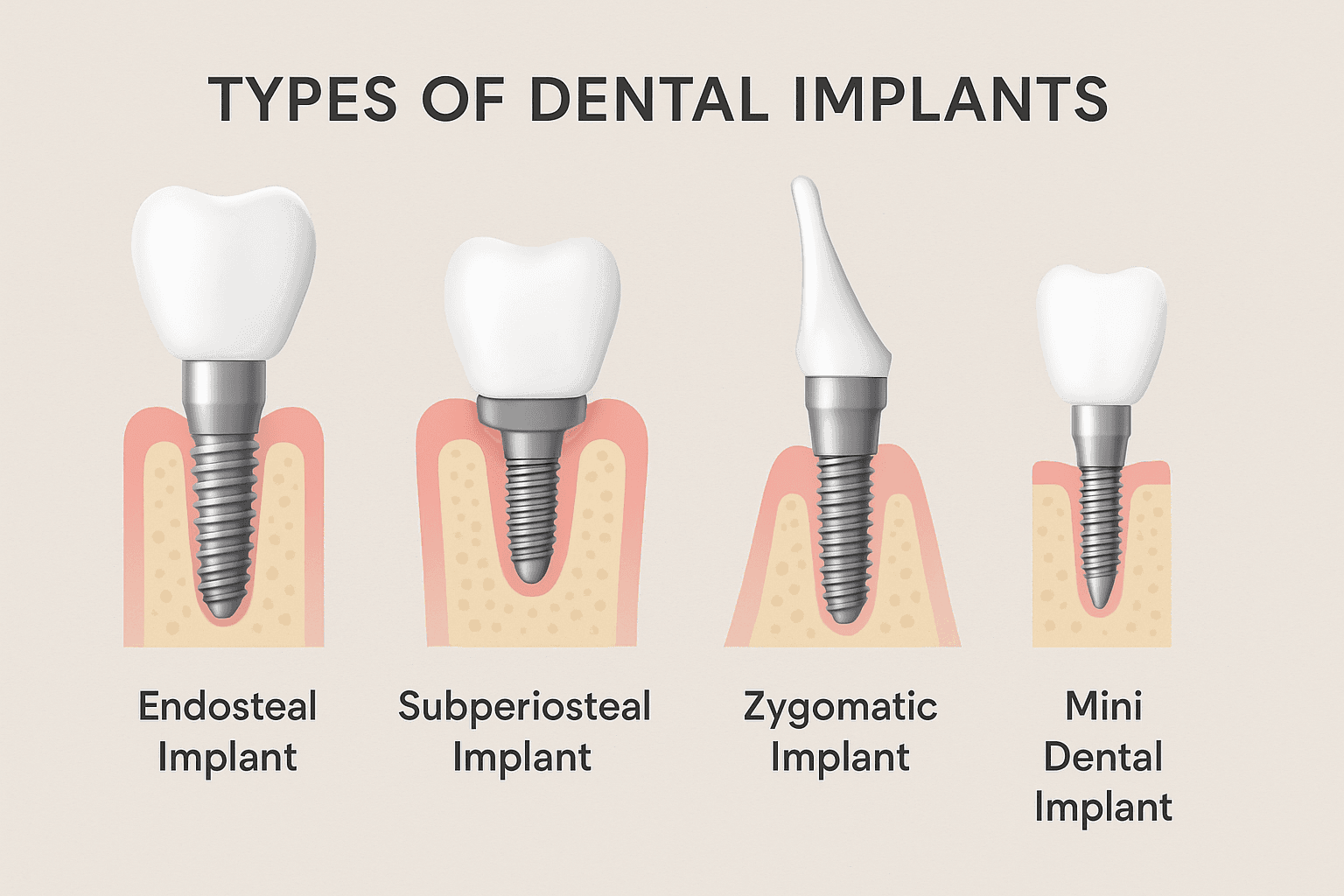
- There are several types of implants, including endosteal implants, subperiosteal, zygomatic, and mini implants.
- Implants support a healthy jawbone by mimicking natural tooth roots and preventing further jaw loss.
- The All-on-4 treatment can replace an arch of missing teeth using four implants.
- With proper care, dental implants can last decades or even a lifetime.
Understanding Dental Implants
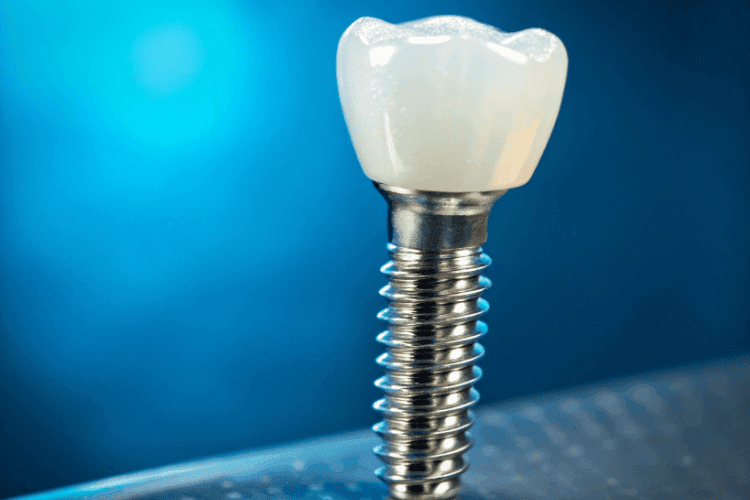
Dental implants are surgically implanted into your jawbone. They act like artificial tooth roots and support replacement teeth. A dental implant is made up of three main parts:
- Implant post – This is the titanium root that is surgically embedded into your jawbone.
- Abutment – The abutment connects the implant to the crown.
- Dental crown – This is the visible part of the artificial tooth that you can see above your gum line.
Unlike removable dentures, implants are fixed in place, so they give you long-term stability. They also stimulate bone tissue and prevent bone resorption (loss of bone mass), which often happens when you are missing teeth.
Implant Dentistry You Can Trust
At Paramount Dental, we deliver patient-first care using state-of-the-art dental technology. Our experienced team, led by Dr. Barinder Cheema, offers advanced dental implant solutions, such as the All-on-4 treatment.
We understand that visiting the dentist can cause anxiety. That’s why we offer expert sedation dentistry and compassionate support to make your experience as comfortable as possible. Our goal is always the same: results you can trust.
We can assist with affordable dental implants in Placerville, dental implants in Yuba City, and in other locations throughout California, such as Sacramento, Penryn, and many more.
Types of Dental Implants
Your dentist will consider different implant types, based on your oral health and the amount of bone available in your jaw. After the initial consultation, your dental professional will create a treatment plan that includes how many teeth need to be replaced, the types of dental implants he or she recommends, and the cost of the entire treatment.
Traditional dental implants (endosteal implants) are the gold standard of tooth replacements, but patients must meet certain requirements to be able to have this treatment. This includes adequate bone density. Dental implants need a certain amount of healthy jawbone for them to be secure in the jaw. If you have lost too much bone for traditional implants, you may need bone grafting before or during the surgical process.
Newer implant options (such as zygomatic implants, mini dental implants, and All-on-4 dental treatment) offer patients with complex cases more flexibility.
Here are the most common types of dental implants to replace missing or damaged teeth:
Endosteal Implants
- The most commonly used dental implant for replacing a single missing tooth.
- They are surgically inserted directly into the upper or lower jaw, where they support replacement teeth.
- Endosteal implants work best for patients with a healthy jawbone.
Subperiosteal Implants
- A subperiosteal implant is placed under your gum tissue, above the jawbone.
- This option is recommended for patients who don’t have enough healthy jawbone to support traditional implants and can’t undergo bone grafting.
- Subperiosteal implants are less invasive but less stable than endosteal implants.
Zygomatic Implants
- Zygomatic implants are anchored into the cheekbone (zygoma) rather than the jawbone.
- Used in the upper jaw for patients who don’t have enough bone for traditional implants.
- Often used as an alternative to bone grafting.
Mini Dental Implants
- Narrower than traditional implants.
- Used for patients with limited bone or smaller teeth.
- They can be used to stabilize lower dentures.
- Requires a less invasive implant procedure.
Dental implants can also provide stability for full or partial arch restorations:
- Implant-supported bridges – These are designed to replace multiple missing teeth in a row, offering a stable and long-lasting alternative to traditional dental bridges.
- Implant-supported dentures – These prosthetics serve as artificial teeth or false teeth, providing a more stable alternative to traditional dentures.
All-on-4 Dental Implants
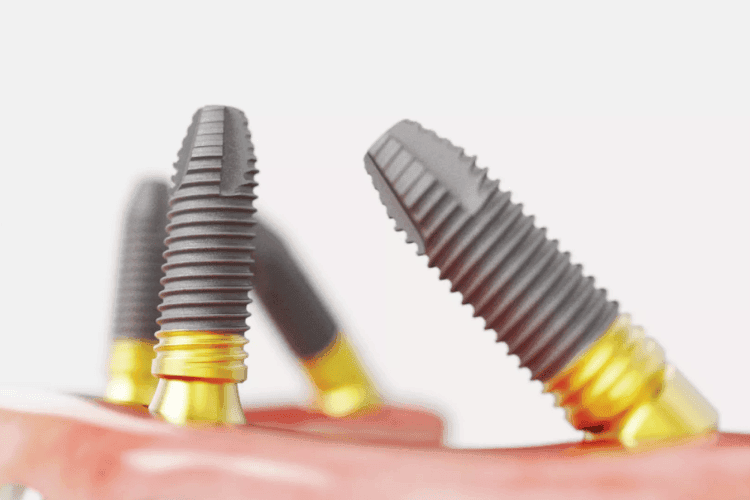
This is an advanced technique where your dentist uses four dental implants to support an arch of replacement teeth (instead of one endosteal implant for each tooth replacement). All-on-4 implant dentures, or full-arch implants, are ideal for patients with severe tooth loss or those who need full-mouth rehabilitation. The implants are placed at an angle, making them suitable for patients who have bone loss.
All-on-4 restorations provide a more secure alternative to removable dentures. At Paramount Dental, our expert team uses 3D imaging and computer-guided placement for precise implant placement and comfort.
The Dental Implant Procedure
You can expect your dental implant surgery to follow these steps:
- Dental exam – Your dentist will perform a physical exam and dental imaging to confirm that you have enough healthy jawbone.
- Surgery – Your dentist places the implants in your jaw.
- Healing – During the healing phase (osseointegration), the bone fuses with the implant over several months, and it becomes part of your jaw.
- Abutment placement – Once healing is complete, the abutment is connected.
- Permanent crown attachment – Once your soft tissue has healed, your dentist will create a custom crown and secure it over the implant post and abutment.
Depending on your dental health and healing process, this dental implant procedure can take several months to a year to complete.
Dental Implant Sizes and Shapes
Implants come in various diameters and lengths:
- Standard dental implants are typically 3.5mm to 4.2mm in diameter.
- Mini implants are less than 3mm in diameter.
- Short implants may be used in patients with reduced vertical bone height.
- Tapered vs. straight designs depend on the bone density and placement area.
Titanium Dental Implants
Titanium implants are the most trusted choice in modern dentistry. They’re known for their strength, biocompatibility, and ability to fuse securely with bone (osseointegration). Titanium implants offer a versatile design and placement.
Zirconia Dental Implants
Zirconia implants are a metal-free alternative to titanium. They’re ideal for patients with metal sensitivities or allergies. Their white color blends naturally with teeth, making them suitable for front-tooth restorations.
Bone Loss and Dental Implants
You need a certain amount of healthy bone in your jaw for your implants to be successful. Unfortunately, when you’ve been missing teeth for a while, you’re likely to experience bone loss in your jaw. Some of the solutions include:
- Bone grafting – This procedure increases jawbone volume using donor or synthetic bone material.
- Zygomatic implants – Avoid bone grafting by anchoring the implant in your cheekbone.
- Mini and short implants – Suitable for patients with moderate bone resorption.
Bone Augmentation and Grafting
When bone loss is too extensive for standard dental implants, your dentist may recommend bone augmentation (rebuilding or thickening the jaw):
- Autografts use your own bone tissue.
- Allografts or xenografts use donor or animal bone.
- Synthetic grafts offer a lab-made alternative.
These procedures improve your chances of implant success and reduce the risk of complications. In some cases, a dentist can perform bone grafting. In more complex cases, you may need an oral surgeon to perform the surgery.
Bone Loss and All-on-4 Dental Implants
One of the advantages of the All-on-4 dental implant system is that two of the implants are placed at an angle, toward the back of the jaw.
Here’s how angled implants help:
- Tilting the posterior implants allows the surgeon to avoid areas where bone has resorbed or deteriorated.
- The angled implants engage more of the available anterior bone, which tends to be denser and better preserved.
- In many cases, this approach eliminates the need for complex and costly bone graft procedures.
Patients who might otherwise be told they need bone grafts to qualify for traditional implants can often proceed with All-on-4 without it. However, patients with severe or extensive bone loss may still need zygomatic implants or other advanced solutions.
If you’ve been told you’re not a candidate for dental implants, please chat to us. The All-on-4 system could work for you.
Load Implants and Immediate Loading
Some patients can receive a temporary crown or bridge on the same day as their implant placement. This is known as immediate load implants. You will wear the temporary tooth until the permanent crown is placed.
Dental Crowns and Restoration Options
The crown is the final touch that makes your implant look and function like a natural tooth. Dentists use different materials for crowns, such as:
- Porcelain and ceramic: Offer a natural appearance and are stain-resistant.
- Zirconia: Known for strength and aesthetics.
- Composite resin: A cost-effective option, though less durable.
Why Dental Implants Are Worth It
Some of the benefits of dental implants include:
- Natural appearance and feel. Implants are the closest tooth replacement option to a natural tooth
- Improved oral health by preventing bone loss and stabilizing adjacent teeth
- A permanent solution for missing teeth
- Enhanced confidence and quality of life
Schedule a Free Consultation
Do you think dental implants might be right for you? At Paramount Dental, we offer a free initial consultation and second opinions. During your initial consultation, we assess your oral health and discuss different types of dental implants to determine the best solution for you. Our team is here to guide you through every step of your smile restoration journey with compassion, expertise, and care you can count on. Call us: (916) 898-0003
References
- American Academy of Implant Dentistry (AAID) n.d., What Are Dental Implants?, AAID.
- Misch, C.E., et al. n.d., ‘Dental implant survival rates: data analysis from literature reviews’, National Institutes of Health (NIH).
- Cleveland Clinic n.d., Dental Implants: What You Should Know, Cleveland Clinic.
- Mayo Clinic n.d., Dental Implants: Risks, Benefits, and What to Expect, Mayo Clinic.
- Esposito, M., Grusovin, M.G., et al. n.d., ‘Interventions for replacing missing teeth: different types of dental implants’, Journal of Prosthodontics.
- Straumann Dental Implants n.d., Clinical documentation on success rates and material types (Titanium vs. Zirconia), Straumann.
- Nobel Biocare n.d., All-on-4® treatment concept: Full-arch rehabilitation with four implants, Nobel Biocare.